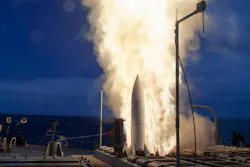
WASHINGTON – U.S. Navy shipboard missile-defense experts are asking RTX Corp. to ramp-up production of the Standard Missile 6 (SM-6) anti-air missile system for surface warships under terms of a $29.2 million order announced Tuesday.
Officials of the Naval Sea Systems Command in Washington are asking the RTX Raytheon segment in Tucson, Ariz., special tooling and special test equipment to increase production capacity of the Standard Missile 6 (SM-6) all-up round.
The SM-6, also called the RIM-174 Standard Extended Range Active Missile (ERAM), is deployed on Navy surface warships like cruisers and destroyers to provide air defense against enemy fixed-wing aircraft, helicopters, unmanned aerial vehicles (UAVs), land-attack anti-ship cruise missiles, and ballistic missiles in their terminal phases over sea and land, Raytheon officials say.
The SM-6 uses the legacy Standard Missile airframe and engine, and adds the advanced signal processing and guidance control capabilities of the Raytheon AIM-120 Advanced Medium-Range Air-to-Air Missile (AMRAAM).
Over-the-horizon defense
The SM-6 is a key component in the U.S. Navy's Naval Integrated Fire Control-Counter Air (NIFC-CA), which helps provide Navy shipboard forces with over-the-horizon air-defense capabilities. It also can destroy nuclear-tipped ballistic missiles in their terminal phases.
The missile features semi-active and active homing, and launches from the MK 41 Vertical Launch System (VLS) canister aboard ship. The SM-6 is a two-stage missile with a booster stage and a second flight stage.
Navy crews inertial guidance to target the missile, and then use the missile's active radar seeker to guide the missile to its target. Other options are using semi-active radar homing all the way; or an over-the-horizon shot with Cooperative Engagement Capability (CEC), which blends radar from several different ships.
Ballistic missile defense
The SM-6 can intercept targets like incoming ballistic missiles at very-high-altitudes, or in low-altitude mode against low fliers like sea-skimming anti-ship missiles. Against ballistic missiles it can discriminate targets using its dual-mode seeker, with the semi-active seeker relying on a ship-based illuminator to highlight the target, and the active seeker having the missile itself send out an electromagnetic signal.
The missile's active seeker can detect a land-based cruise missile amid ground clutter, even from behind a mountain. The Navy is adding the Global Positioning System (GPS) to the SM-6 so it can strike stationary land targets if needed. The missile also is being modified as an anti-ship weapon.
On this order Raytheon will do the work in Tucson, Ariz.; Middletown, Conn.; and Westminster, Md., and should be finished by September 2028. For more information contact RTX Raytheon online at www.rtx.com/raytheon/what-we-do/sea/sm-6-missile, or Naval Sea Systems Command at www.navsea.navy.mil.